.png)
Dividend Investing for Beginners: How to Earn Passive Income in Canada 💰📈


Imagine getting paid just for owning stocks. Not from selling them. Not from trading. Just from holding them in your account while companies send you money every few months.
That's dividend investing. And it's one of the most beginner-friendly ways to build passive income in Canada.
You've probably heard people talk about "living off dividends" or "building a dividend portfolio." It sounds almost too good to be true - getting paid to do nothing. But it's real, it's accessible, and you can start with way less money than you think.
Let's break down exactly what dividends are, how dividend investing works in Canada, and how to start building your own passive income stream today.
⚠️ Important Disclaimer
We (Northern Finance) are not a financial advisor, and this article is for educational purposes only. The information here is based on research and general investing principles, but everyone's financial situation is different. We are not responsible for any financial decisions you make based on this content. Always do your own research and consider talking to a licensed financial professional before making investment decisions.
What You'll Learn
⚡ TL;DR - The Quick Version
In a rush? Here's what you need to know:
Dividends are cash payments companies make to shareholders, usually quarterly
Canadian dividends get special tax treatment - you pay less tax than on regular income
Dividend yield shows annual payout as percentage of stock price (4% yield = $4/year per $100 invested)
You need roughly $300,000 invested to generate $1,000/month in dividends at 4% yield
Best beginner approach: Canadian bank stocks, utilities, and dividend ETFs for instant diversification
Dividends compound when reinvested to accelerate wealth building
Keep reading to learn how to actually build a dividend income stream from scratch.
💵 What Are Dividends and How Do They Work?
📋 Simple definition:
A dividend is a cash payment a company makes to its shareholders, usually every 3 months (quarterly). It's the company sharing its profits with you.
💼 Real-world example:
You buy 100 shares of Royal Bank (RBC) at $130/share = $13,000 investment. RBC pays $1.38 per share annually in dividends. You receive $138/year ($34.50 every quarter) just for owning the stock.
You didn't sell anything. The money just shows up in your account.
💡 Did You Know? Canadian banks have paid dividends for over 100 years without interruption. Even during the 2008 financial crisis, they kept paying shareholders.
🔄 How dividend payments work:
Declaration date: Company announces dividend amount
Ex-dividend date: Must own stock before this date to get paid
Payment date: Money hits your account (2-4 weeks later)
Most Canadian dividend stocks pay quarterly. Some pay monthly.
🎯 What you can do with dividends:
💸 Take the cash: Use it as income
🔄 Reinvest: Buy more shares automatically (DRIP - Dividend Reinvestment Plan)
🛍️ Spend it: Whatever you want
🔗 Learn more about building wealth through investing in our beginner's investment guide.
🍁 Why Canadian Dividends Are Tax-Advantaged
Here's where it gets interesting: dividends are taxed differently (and better) than regular income in Canada.
💰 Tax comparison (Ontario, $50k income):
$1,000 in salary income: Pay ~$300 in tax
$1,000 in Canadian dividends: Pay ~$150 in tax
You keep an extra $150 with dividend income
💡 Did You Know? In Canada, you can earn roughly $30,000-$50,000 per year in dividend income with minimal to zero tax if it's your only income (varies by province).
🏦 TFSA advantage:
Hold dividend stocks in your TFSA = ZERO tax ever. Not reduced tax. Zero. The dividends grow tax-free forever.
This is why Canadian dividend investing in a TFSA is so powerful.

📊 Dividend Yield vs Dividend Growth Explained
🔢 Dividend Yield:
The annual dividend payment as a percentage of the current stock price.
📐 Formula: (Annual dividend ÷ Stock price) × 100
💡 Example:
Stock price: $50
Annual dividend: $2
Yield: 4%
This means for every $100 invested, you get $4/year in dividends.
⚖️ High yield vs low yield:
🔥 High yield (5-8%+):
✅ More immediate income
❌ Often slower stock price growth
❌ Sometimes unsustainable (red flag if over 10%)
🌱 Low yield (1-3%):
✅ Usually faster dividend growth over time
✅ Better stock price appreciation
❌ Less immediate income
🗣️ "Should I chase the highest yield possible?"
No. Super high yields (10%+) are often red flags. The company might be struggling and could cut the dividend. Aim for 3-6% yields from stable companies.
📈 Dividend Growth:
How much the company increases its dividend payment each year.
📊 Example:
Year 1: $1.00/share dividend
Year 2: $1.05/share (5% growth)
Year 10: Your original 3% yield is now 6% on your cost
💡 Did You Know? Canadian banks have increased their dividends by an average of 7-10% annually over the past 20 years.
💰 How Much You Need to Invest for Real Income
Let's get realistic about numbers.
🎯 Monthly income goals at 4% yield:
$500/month ($6,000/year): Need $150,000 invested
$1,000/month ($12,000/year): Need $300,000 invested
$3,000/month ($36,000/year): Need $900,000 invested
🗣️ "That's impossible! I don't have $300,000!"
You build to it over 10-20+ years through regular contributions, reinvested dividends, and dividend growth.
📈 Realistic timeline starting with $5,000 + $500/month:
⏰ Year 5: ~$35,000 invested, ~$1,400/year in dividends
⏰ Year 10: ~$80,000 invested, ~$3,600/year
⏰ Year 20: ~$200,000 invested, ~$10,000/year
⏰ Year 30: ~$400,000+ invested, ~$20,000+/year
(Assuming 4% yield, 6% total return, dividends reinvested)
The first years feel slow. But compound growth accelerates over time.
🏆 Best Canadian Dividend Stocks for Beginners
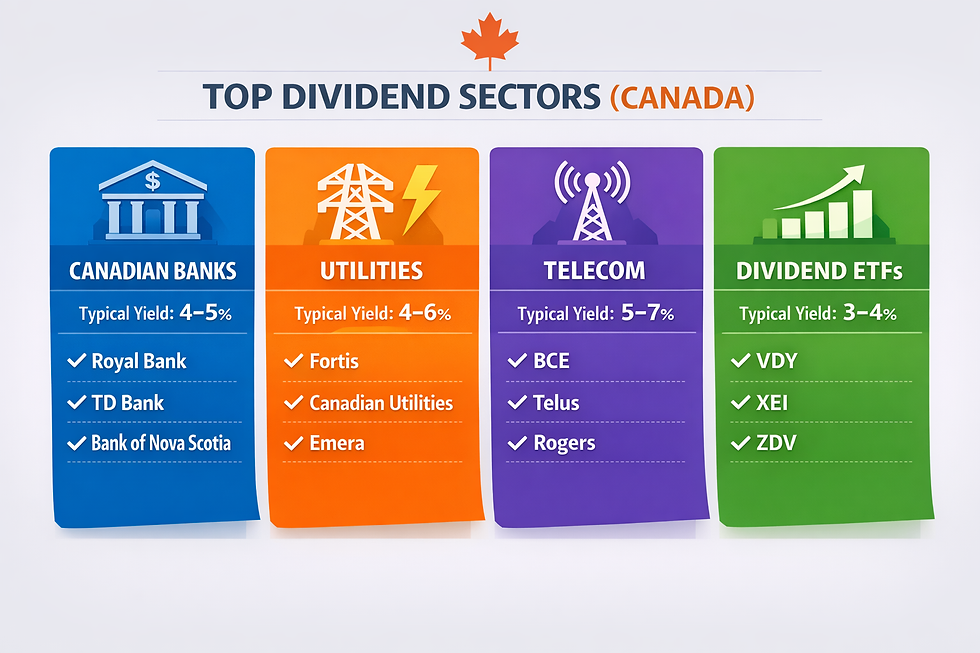
🏦 Canadian Banks (Safest Bet):
✅ Why they're great: Stable, regulated, 100+ years of dividend history, 4-5% yields
🌟 Top picks: Royal Bank (RBC), TD Bank, Bank of Nova Scotia
💵 Average yield: 4-5%
⚡ Utilities (Boring But Reliable):
✅ Why they're great: Everyone needs electricity/gas, regulated monopolies
🌟 Top picks: Fortis, Emera, Canadian Utilities
💵 Average yield: 4-6%
📞 Telecom (High Yield):
✅ Why they're great: Essential services, high barriers to entry
🌟 Top picks: BCE (Bell), Telus, Rogers
💵 Average yield: 5-7%
🎯 Dividend ETFs (Easiest for Beginners):
✅ Why they're great: Instant diversification, automatic dividend collection
🌟 Top picks:
XDV (iShares Canadian Dividend) - 75 stocks, 4% yield
VDY (Vanguard Canadian Dividend) - Similar holdings
ZDV (BMO Canadian Dividend) - Another solid option
💵 Average yield: 3-4%💳 Fees: 0.10-0.30%
💡 Did You Know? Buying XDV gives you exposure to 75 Canadian dividend stocks in one purchase. Perfect for beginners.
🔗 Check TMX Money for current dividend yields.
✅ How to Build Your First Dividend Portfolio
🎯 Step-by-step beginner strategy:
📱 Step 1: Choose your account
🏦 TFSA: Best for most - tax-free dividends, withdraw anytime
📊 RRSP: Better if high tax bracket now
Start with TFSA.
💳 Step 2: Pick your platform
💚 Wealthsimple Trade: $0 commissions (easiest)
🔷 Questrade: $0 to buy ETFs
🏦 Your bank: Convenient but higher fees
🎯 Step 3: Decide your strategy
🟢 Option A - Super Simple (Recommended):
Buy one dividend ETF (XDV, VDY, or ZDV)
Set up automatic monthly contributions
Reinvest dividends automatically
Done.

🔵 Option B - Build Your Own:
Pick 5-10 individual stocks
Diversify across sectors
Manually reinvest or use DRIP
💰 Step 4: Start small and automate
Invest $100-500/month consistently.
🔄 Step 5: Reinvest dividends (DRIP)
Use Dividend Reinvestment Plans to automatically buy more shares. This is how you compound wealth.
📊 Sample beginner portfolio ($5,000):
🟢 Simple approach:
100% XDV dividend ETF
🔵 DIY approach:
30% RBC (bank)
20% Fortis (utility)
20% BCE (telecom)
15% Loblaw (consumer)
15% XDV (diversification)
Both work. Simple is easier to stick with.
🤔 Quick Q&A
💬 Do I pay tax on dividends in my TFSA?
No! Dividends in a TFSA are 100% tax-free.
💬 What happens if a company cuts its dividend?
Stock price usually drops, your income decreases. This is why diversification matters.
💬 Should I focus on high yield or dividend growth?
Need income now? Higher yield. Building for 20+ years? Dividend growth compounds better.
💬 How often should I check my portfolio?
Quarterly when dividends pay, or monthly when you add money. Don't obsess over daily prices.
💪 The Bottom Line
Dividend investing isn't a get-rich-quick scheme. It's a build-wealth-steadily strategy that compounds over decades.
🎯 The reality:
You won't "live off dividends" in year one
It takes years to build meaningful income
But once built, it's passive income that grows automatically
Canadian tax advantages make it even better
✅ Your action plan:
Open a TFSA investment account (Wealthsimple or Questrade)
Start with a dividend ETF (XDV or VDY)
Invest $100-500/month consistently
Reinvest all dividends automatically
Add individual stocks later as you learn
Be patient - this is a 10-20+ year strategy
💰 What you'll achieve:
In 10 years with consistent investing, you could generate $2,000-5,000/year in passive dividend income.
In 20 years? $10,000-20,000+/year.
In 30 years? Potentially enough to supplement or replace job income.
The companies pay you. You reinvest. The dividends grow. Your wealth compounds.
Start small, stay consistent, and let Canadian dividend stocks pay you for decades. 🍁💰
🔗 Learn about tax-advantaged accounts in our TFSA vs RRSP guide.


